DC Connectors and Cable Pairing
A connector is only as good as the cable it is paired with, and three published numbers settle that pairing: the conductor cross-section, the strand count and the overall diameter. KUKA CABLE lists a solar cable connector range beside its DC cable, and its table gives 4 mm² as 56 strands of 0.29 mm inside a 5.5 mm sheath, 6 mm² as 84 strands at 6.0 mm and 10 mm² as 142 strands at 7.5 mm.
Key takeaways
- Pair on the printed diameter and not on the nominal size, since 4 mm², 6 mm² and 10 mm² measure 5.5 mm, 6.0 mm and 7.5 mm and differ by half a millimetre at a time.
- Stranding matters to the crimp: the published conductor is tinned copper, class 5 flexible to IEC 60228, at 56, 84 and 142 strands for those three sizes.
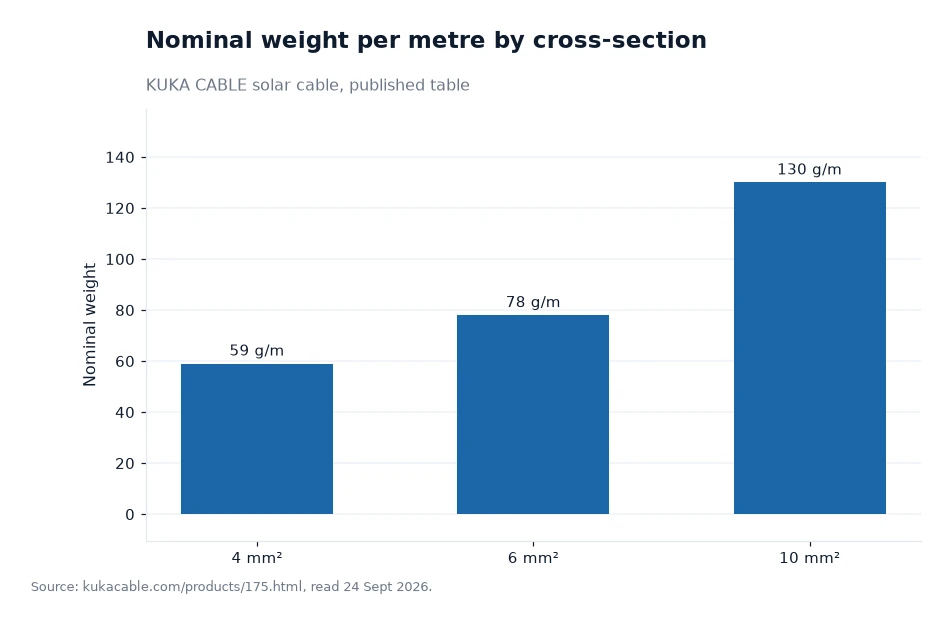
- Weight per metre runs 59 g, 78 g and 130 g, which turns a fifty metre span into 2.95 kg, 3.9 kg and 6.5 kg by my own multiplication and puts a number on strain relief.
- The connector range covers MC4 style contacts, fuse connectors, diode connectors and finished PV cable assemblies, with a CE and RoHS certificate download on one of those pages.
The three numbers that decide a pairing
The first number is the conductor range the contact is machined for. A contact built for 4 mm² to 6 mm² will not close properly on a 10 mm² flexible conductor, and one built for 10 mm² swallows a smaller core without applying the pressure the joint needs.
The second is the stranding. Class 5 flexible conductors compress under a correct crimp, and the published figures are 56 strands of 0.29 mm at 4 mm², 84 at 6 mm² and 142 at 10 mm², all tinned. A crimp die chosen for a rigid conductor will leave voids in a flexible one, and voids are where moisture and heat begin.
The third is the overall diameter, because the rear of a connector holds a sealing gland and a strain relief sized in millimetres. Published diameters are 5.5 mm, 6.0 mm and 7.5 mm across those three sizes, which is a narrower spread than the cross-sections suggest and the reason a part cannot be chosen by eye.
What the published weights say about strain relief
Weight is the number that turns a joint into a mechanical question rather than an electrical one. At 78 g per metre, a fifty metre length of 6 mm² weighs 3.9 kg by my own multiplication; the same length in 10 mm² weighs 6.5 kg at 130 g per metre, and in 4 mm² it weighs 2.95 kg at 59 g per metre.
No contact is designed to hold that mass. A cable that hangs from its plug instead of its clips puts a permanent load on the crimp and on the sealing gland, and the load rises every time the cable moves with wind or with thermal expansion.
The published answer is the clip, and the clip's size comes from the diameter figure. A clip that grips a 6.0 mm cable will not close on a 7.5 mm one, so the pairing exercise runs the whole length of the route rather than stopping at the connector body.
What the manufacturer lists beside the cable
The published connector range covers MC4 style solar connectors, solar fuse connectors, solar diode connectors and PV cable assemblies, which is a wider set than a single plug. Fuse and diode connectors exist because a string sometimes needs protection at the joint rather than at the inverter, and an assembly exists because a terminated length can be tested before it is packed.
One of the connector pages carries a CE and RoHS certificate download, and the certificates page counts more than 30 certificate types with TUV, IEC, CE, SAA and UL among them, the UL entry being described as in the process of updating. Regional requirements such as the CPR fire rating and an AD8 waterproofing rating are named as well.
What the site does not publish is a contact resistance in milliohms, a mating-cycle count or a current rating for each contact. A buyer who needs those values has to request them, and the request is easier to answer when it names the cable size, the current and the number of times the joint will be opened.
Single-core, twin-core and the connector choice
The cable family has both forms. A single-core construction gives one conductor per jacket and lets the two poles be routed separately; a twin-core construction puts both inside one jacket and takes a single clip at each fixing point, which changes the connector work rather than the conductor.
On a twin-core cable the connector has to accept the jacket diameter as a unit, and the two cores inside it are terminated separately. That is a different gland and a different strain relief from a single-core run, and it is the point at which a bill of materials written for single-core cable quietly stops fitting.
The published range includes a twin-core version for that reason, alongside H1Z2Z2-K, PV1-F, UL 4703 and 1500 V models. A buyer choosing a solar dc cable in one form or the other is choosing a routing method and a fixing count rather than a different electrical rating, since the 1500 V construction carries DC 1.8/1.8 kV and a 6.5 kV AC test at 50 Hz for five minutes in either form.
The published figures in one table
The table repeats the three numbers that decide a pairing for the sizes most often used on a string, drawn from the manufacturer's cross-section table. Construction and diameter are published values; the right-hand column is my own note on what each one implies for a joint, added so the arithmetic is not left to the reader.
| Nominal cross-section | Conductor construction | Overall diameter | Weight per metre |
|---|---|---|---|
| 1.5 mm² | 39 × 0.25 mm | 4.6 mm | 34 g/m |
| 2.5 mm² | 49 × 0.25 mm | 5.0 mm | 45 g/m |
| 4 mm² | 56 × 0.29 mm | 5.5 mm | 59 g/m |
| 6 mm² | 84 × 0.29 mm | 6.0 mm | 78 g/m |
| 10 mm² | 142 × 0.29 mm | 7.5 mm | 130 g/m |
| 16 mm² | 238 × 0.29 mm | 8.8 mm | 190 g/m |
Worked example: bending radius and a fifty metre span
Start with the bend. Applying the published rule of four times the outer diameter, a 4 mm² cable takes a 22 mm radius, a 6 mm² cable 24 mm and a 10 mm² cable 30 mm, which is my own arithmetic on the published diameters of 5.5 mm, 6.0 mm and 7.5 mm, assuming one bend at room temperature with no tension.
Now hang that cable. Fifty metres of 6 mm² is 3.9 kg by my own multiplication, and every one of those kilograms is transferred to the connector unless a clip carries it. Space the clips so the load drops to the mounting surface, and the connector only has to hold current.
The heat side of the pairing has published limits too: the conductor may reach +120 °C for 20,000 hours or +250 °C for 5 seconds, against an ambient range of −40 °C to +90 °C. Those numbers describe what the cable tolerates, and the client states that its SIF quality model includes 100% inspection of finished products with sample retention for traceability.
Frequently asked questions
How do I choose a connector for a given cable size?
Work from three published numbers. The conductor range the contact accepts, the stranding of the core, and the overall diameter of the sheath. The manufacturer publishes 56 strands of 0.29 mm in a 5.5 mm cable at 4 mm², 84 strands in a 6.0 mm cable at 6 mm² and 142 strands in a 7.5 mm cable at 10 mm², with tinned class 5 copper to IEC 60228. The site does not publish a current rating per contact, so ask for that together with the mating-cycle count.
Does a heavier cross-section need a different strain relief?
Yes, because the load grows with the weight. The published weights are 59 g per metre at 4 mm², 78 g at 6 mm² and 130 g at 10 mm², so fifty metres weighs 2.95 kg, 3.9 kg and 6.5 kg by my own multiplication. Clips sized to the published diameter, 5.5 mm, 6.0 mm and 7.5 mm, carry that load, and the connector is left to do the electrical job it was designed for.
What to put on the connector order
Write the cable size, the strand construction, the measured sheath diameter, the colour and the number of cores on the order, then ask for the current rating and the mating-cycle figure that the site does not publish. Those four values are what a supplier needs in order to answer with a part rather than with a category.
The manufacturer offers free samples and downloadable data sheets, and its published test list shows which checks a finished cable passes, and its product consultant service is described as covering the enquiry, the delivery and the after-sales maintenance of an order. Prices, minimum quantities and lead times are not published on the site, so the sample and the quotation remain the two documents that carry a first order forward.
Figures in this connector-pairing article come from the manufacturer's own website; the nominal weights listed here were browsed 24 Sept 2026[1].